Nerve
Voltage-gated sodium channels open, Na⁺ enters, and depolarisation initiates and propagates the impulse.
An edible rock set humans in motion.
Sodium was indispensable, while accessible deposits were distributed capriciously. People boiled springs, broke pots, dripped water over salt mountains, burned plants, drilled wells and designed blocks around the width of a camel.
Sodium dominates the fluid outside animal cells; potassium dominates inside. The body spends energy preserving that asymmetry, then uses it as a reserve of voltage, transport and movement.
Na⁺/K⁺ pump uses ATP and, in each cycle, moves three sodium ions out of the cell and two potassium ions in. The difference stores electrochemical energy across the membrane. When the appropriate channels open, ions move rapidly and change the cell’s voltage.
The gradient is not a permanent current running through the body. It is a microscopic battery that is continuously recharged. It enables nerve impulses, muscle-fibre excitation and the transport of some nutrients. “Electricity made edible” is an editorial synthesis; the mechanism is measurable physiology.
Voltage-gated sodium channels open, Na⁺ enters, and depolarisation initiates and propagates the impulse.
The impulse crosses the muscle fibre, triggers calcium release and enables contraction.
The sodium gradient helps intestinal cells transport glucose. The same principle underlies oral rehydration.
The pump spends ATP to restore the difference: 3 Na⁺ out, 2 K⁺ in, cycle after cycle.
The membrane preserves a charge difference. Sodium is concentrated outside and potassium inside.
Sodium appetite is innate and nutrient-specific. When sodium balance or extracellular fluid volume falls, hormonal signals and neural circuits intensify salt seeking. Depletion raises tolerance for concentrations a sated animal would avoid. Sodium sensed in the mouth and gut begins quieting the drive before the mineral has fully corrected the blood.
On land, especially for herbivores and frugivores, a landscape may be rich in calories and potassium while remaining poor in sodium. Mineral licks become repeated and sometimes dangerous destinations. A camera-trap and soil study of 52 Amazonian licks supported sodium supplementation for several species.
A forest full of food can still be a sodium desert.
Evolution did not give the deer a lecture on electrolytes. It gave it a route remembered by the body.
Tapirs, howler monkeys, agoutis and other mammals converge on patches of soil that concentrate minerals scarce in their diets. Licks can become meeting places, inherited routes and points of predation risk.
Sodium is indispensable; a high intake brings no extra benefit. Dietary excess raises blood pressure and cardiovascular risk. Potassium in food can mitigate the effect on blood pressure, but it does not make a very high salt intake neutral.
Every technique solves the same equation: locate salt, separate it from water or rock, then make the product concentrated and portable enough to move. Choose a landscape.
You have brine, fuel and vessels.
Boil the liquid. When pots act as moulds, break them to release a transportable salt cake. Poiana Slatinei and early Añana follow this logic.
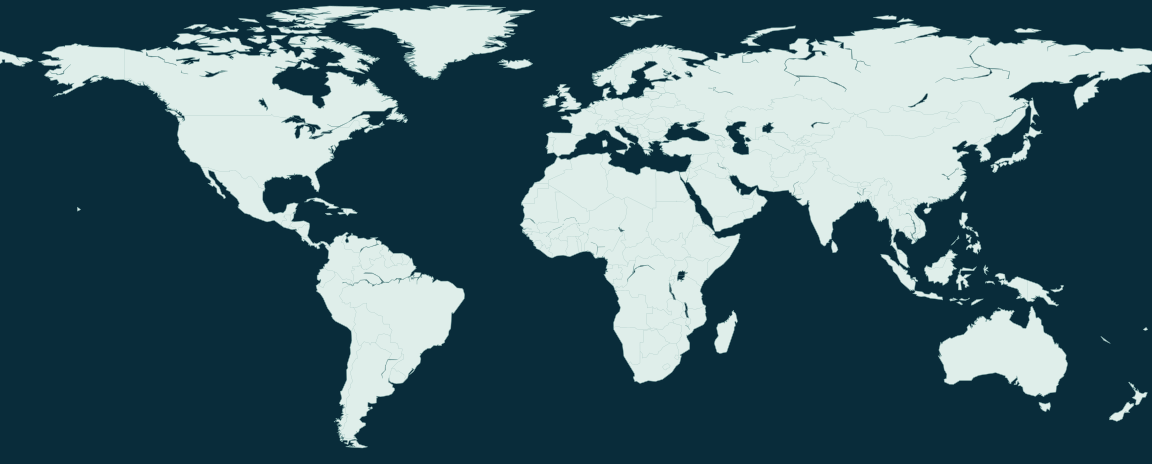
Examples in the atlasThe map follows well-documented solutions rather than attempting completeness. Filter by the dominant operation, then open each place. Switch to routes to see how salt travelled.
Beside a spring containing about 160 g of salt per litre, Neolithic communities burned large quantities of fuel to evaporate water from the brine. Layers of ash, charcoal and fired earth accumulated into a mound almost three metres high. Production turned a heavy liquid into crystals or compact cakes that could travel.
Open sourceThe more productive Adriatic saltworks pulled the road to the east coast.
Open sourceBeside a spring containing about 160 g of salt per litre, Neolithic communities burned large quantities of fuel to evaporate water from the brine. Layers of ash, charcoal and fired earth accumulated into a mound almost three metres high. Production turned a heavy liquid into crystals or compact cakes that could travel.
The earliest works boiled brine in ceramic pots and broke the vessels to release salt cakes. In the Roman period, clay platforms enabled natural evaporation. Today wooden channels distribute spring brine across thousands of crystallisation surfaces.
Tides bring Atlantic water into storage ponds, then gravity carries it through evaporation and crystallisation ponds. Sun and wind gradually remove water from the brine. Extremely fine flakes form on the surface and are lifted by hand with a special tool called a coador before the remaining salt settles to the bottom. The movement must be gentle enough to leave the surface unruffled.
Hollowed tree trunks, perforated and fitted with wooden plugs, delivered rows of drips onto rock salt. Water cut depressions and initiated cracks. Workers drove wooden wedges with heavy mallets until blocks gave way. Modern experiments show that the method works strikingly well.
Deep galleries extracted salt from the mountain at scale. The dry, saline environment preserved objects that usually vanish: dyed textiles, leather, ropes, handles, food remains and even faeces. The mine records the labour, diet and logistics of a prehistoric industry.
Thousands of ceramic fragments, clay-lined pits and chemical traces document long-running brine processing. Vessel forms changed radically twice. Production expanded from seasonal work toward specialised output for long-distance exchange.
Beneath the lagoon floor, wooden posts, hearths, vessels and brine-enrichment installations survived. At least 110 sites formed a coastal industry. Salty water was passed through saline soil, then the stronger liquid was boiled in specialised salt kitchens.
At the foot of the Western Rift escarpment, hot springs salt the ground. Women repeatedly spread dry earth over wet deposits, let it absorb salts, leach it and boil the resulting liquid. The same soil returns to the “salt gardens”.
Where mineral sodium chloride was hard to reach, plants supplied other salts. Plant material was burned, the ash leached with water, and the liquid boiled to dryness. One study documented salts from 57 species, with different compositions and uses.
On a coast where terrain prevented a conventional low saltern, workers carried seawater to raised fields. They scattered it over sand, dried and stirred the surface, then washed the salty sand to obtain concentrated brine. Boiling produced the final crystals.
Salt layers in a sebkha are exposed in trenches and cut by hand into standard slabs. The block solves a transport problem: one slab on each side of a camel, moving hundreds of kilometres toward Timbuktu and Sahelian markets.
Repeated percussion by a heavy bit on bamboo cable enabled progressively deeper wells. Bamboo tubes cased the bore, recovery tools retrieved broken equipment, and natural gas associated with the brine fired the boiling houses. The Shenhai Well passed one kilometre in 1835.
Continuous extraction created hundreds of kilometres of galleries, chambers, workshops, stores and chapels. The Saltworks Castle administered production and sales. Salt appears here as a complete industrial system: labour, technology, taxation, faith and art beneath one mountain.
The more productive Adriatic saltworks pulled the road to the east coast.
ox cart, on foot · documented
Slabs of ~60 kg; winter 1939–40: over 4,000 camels.
camel caravan · partly approximate
Salt and natron for millet, twice a year.
camel caravan · documented
The Shenhai well passed 1,000 m in 1835; the wells' gas boiled the brine.
Yangtze river boat · documented
The Reichenhall–Traunstein brine pipeline has run since 1616.
cart, brine pipeline · documented
In the 16th century: ~19,000 tons/year from Lüneburg to Lübeck.
cart, barge (from 1398) · documented
Blocks cut at Turda and Ocna Mureș, floated down to Szeged.
raft and barge · documented
The exact prehistoric itinerary is undocumented; the Traun–Danube corridor is.
valley + river · approximate corridor
The Băile Figa trough did not concentrate brine efficiently. Experiments support a more ingenious function: rows of drips cut depressions in rock salt and initiated cracks into which wedges could be driven.
Innovation did not travel in one direction. Fire, sunlight, sand, wood, pottery, animals and drilling remained useful in different combinations.
During the Little Ice Age, colder weather reduced solar-salt output and raised the value of inland salt. The political consequence depended on where production had to pass.
Mining required capital, and the salt crossed a visible chokepoint. A ruler could guard the entrance, count the loads and monopolise the revenue.
Scattered springs could be boiled by many small producers. Production was harder for a central authority to observe, stop and seize.
“War made the state only where the fiscal sinews of war were appropriable.”Desierto, Fitzsimmons and Koyama
Boiling and crystallisation turn heavy water into compact goods. A cake, slab or sack can leave the spring.
Pots, moulds and slabs give the product repeatable units. At Taoudenni the block fits the camel load.
Rich sources attract roads, caravans, ports and markets. Distance between deposit and consumer creates intermediaries.
A necessary, taxable resource invites monopoly. Imperial China and European royal mines turned salt into public revenue.
Salt extends the time of food. Fish, meat, cheese and vegetables can travel and cross seasons.
Salt places preserve techniques and societies. Hallstatt keeps organic objects; medieval mines preserve labour organisation in galleries.
Tomorrow, keep the image of the Transylvanian trough. A row of drips falls for hours onto salt. Holes deepen, cracks join, a wedge enters the line, and the mountain yields exactly where water prepared it. The wider history fits inside that gesture: people learned a mineral’s properties until geology became technology.
Innate, nutrient-specific sodium appetite; neural and hormonal control; anticipatory satiation.
open
Feed-forward control of sodium appetite and rapid quenching by oral sodium signals.
open
Salt can increase the salience of desirable flavours by suppressing bitterness.
abstract
The sodium-potassium pump maintains animal-cell ion gradients; each cycle exports three sodium ions and imports two potassium ions using ATP.
open
Voltage-gated sodium channels initiate action potentials in nerve, muscle and other excitable cells.
open
Sodium entry and potassium exit generate muscle action potentials; the resulting excitation enables calcium release and contraction.
open
The sodium gradient drives coupled glucose uptake in the small intestine and other tissues.
open
Sodium depletion increases salt appetite and tolerance through distinct mammalian neural pathways.
open
Camera traps and soil analyses at 52 mineral licks support sodium supplementation for several Amazonian herbivores and frugivores.
open
Early Neolithic brine exploitation at Poiana Slatinei-Lunca, dated 6050–5500 BCE; spring concentration around 160 g/L.
open
Perforated wooden troughs dated broadly 1500–900 BCE; experiments support controlled dripping to fracture rock salt.
open
Prehistoric fire evaporation in ceramic vessels; later transition to natural evaporation pans.
open
Atlantic water circulates by gravity through storage, evaporation and crystallisation ponds; flor de sal is lifted by hand from the surface with a coador before the remaining salt settles to the bottom.
open
Bronze and Iron Age mining; salt-rich conditions preserve textiles, leather, wood, ropes, food and other organics.
open
Chemical and archaeological evidence for large-scale pottery-based salt production at Zhongba; sequence from late Neolithic through Bronze Age.
open
One of 110 Paynes Creek salt works; salt kitchens, brine enrichment and boiling, AD 600–900.
abstract
Women leach repeatedly enriched saline soil and boil the brine; archaeological continuity for roughly 700–800 years.
abstract
Vegetable salts from 57 plant species made by burning plants, leaching ash and boiling the liquid.
abstract
Seawater carried to raised sand fields, sprayed and dried, then leached and boiled; more than 400 years of documented continuity.
open
Taoudenni hand-mining and slab transport; long persistence of the technology and caravan economy.
abstract
More than 2,000 years of well-salt culture, preserved drilling and production sites, and the Shenhai Well tradition.
open
Continuous mining from the 13th century and the development of a major European industrial system.
open
Sodium is essential, while high dietary intake raises blood pressure and cardiovascular risk; potassium can mitigate blood-pressure effects without making high sodium intake neutral.
open
Practical UK public-health guidance on dietary salt and the health effects of excessive intake.
open
Salarium was a regular payment or allowance in the Roman imperial period and is etymologically associated with Latin sal, salt.
abstract
The word salary ultimately connects to Latin salarium and salt, while the familiar claim that Roman soldiers were literally paid in salt lacks secure ancient evidence.
open
Across 251 historical European salt sites, colder periods are associated with consolidation around appropriable rock salt and greater fragmentation around dispersed brine. The strongest instrumental-variable evidence concerns brine.
open PDF
Rome to the Adriatic salt road; Sabine origins; the name covers the Rome to Castrum Truentinum line.
open
Timbuktu to Taoudenni caravan organization; rock-salt slabs carried by camel.
open
Kaouar oasis salt and natron pans; the Agadez to Bilma caravan axis.
open
Lüneburg to Lübeck overland route, 116 km; barrelled salt; Stecknitz Canal from 1398.
open
Royal saltworks at Bad Reichenhall; endpoint of the Bavarian brine pipelines.
open
Turda salt massif and mining history; Mureș distribution downstream to Szeged.
open
Examples were selected because they show distinct material operations and rest on publicly verifiable evidence. The map is schematic and points indicate a site or region. Routes are schematic corridors, and displayed distances are documented figures rather than map measurements. Borders in the political study come from a separate dataset for medieval and early modern Europe. Sources last checked 18 September 2026.